I am interested in the representations and processes people use to reason about space. "Space," of course, is an extremely broad domain, so my research focuses on people's ability to compare and find patterns across two-dimensional images. Although these stimuli are simpler than the objects and scenes people encounter in the real world, I believe they are valuable for two reasons:
1) The ability to examine, compare, and mentally manipulate 2d images is important in a number of disciplines (geoscience, chemistry, surgery, dentistry, engineering, circuit design, etc). Childhood performance on 2d spatial ability tests like mental rotation predicts future achievement in these disciplines (Wai, Lubinski, & Benbow, 2009).
2) 2d problem-solving ability correlates with ability in other, non-visual domains. Performance on Raven's Progressive Matrices was found to be the best single predictor of performance across a wide variety of other intelligence tests, both spatial and verbal (Snow, Kyllonen, & Marshalek, 1984).
My approach combines two methodologies: computational modeling and behavioral experimentation. The models, which are fully automated, perform tasks such as those shown to the right. They include processes for constructing representations from line drawings and for reasoning over those representations. They are useful for evaluating psychological theories and developing testable hypotheses.
My core claim is that a key challenge in any spatial problem-solving task, or even in a basic comparison between two images, is finding the appropriate representation, the one which focuses on the critical features of the scene while filtering out irrelevant details. I believe that being able to find the right representation is a key skill underlying spatial ability, and intelligence more broadly. Below, I give two examples I have explored with computational models:
1) To solve a Raven's Matrix problem, one must compare the images in a row or column and determine what is changing between them. However, before this can be done one must carve the images into meaningful objects. This isn't always easy. For example, the problem at the upper right corner of this page becomes clearer if one imagines that each image in the top row contains an hourglass figure.
2) Mental rotation tasks are typically solved by imagining one figure rotating to align it with the other. The time required to perform a rotation often increases with the complexity of the figures. However, one can address this by abstracting away the unnecessary details, producing a simplified representation for even the most complex shapes.

Could the left shape be rotated to produce the right shape?

If the squares were folded up to form a cube, would the arrows meet?
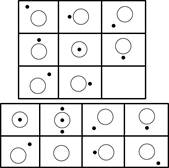
Pick the answer that best
completes the matrix.
(not an actual problem from the test)
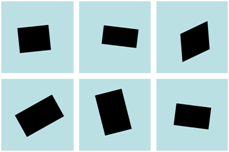
Pick the one that doesn't belong.